
Care & How-To
Olive Wood Utensils: The Complete Guide
By Randall · 7/22/2026
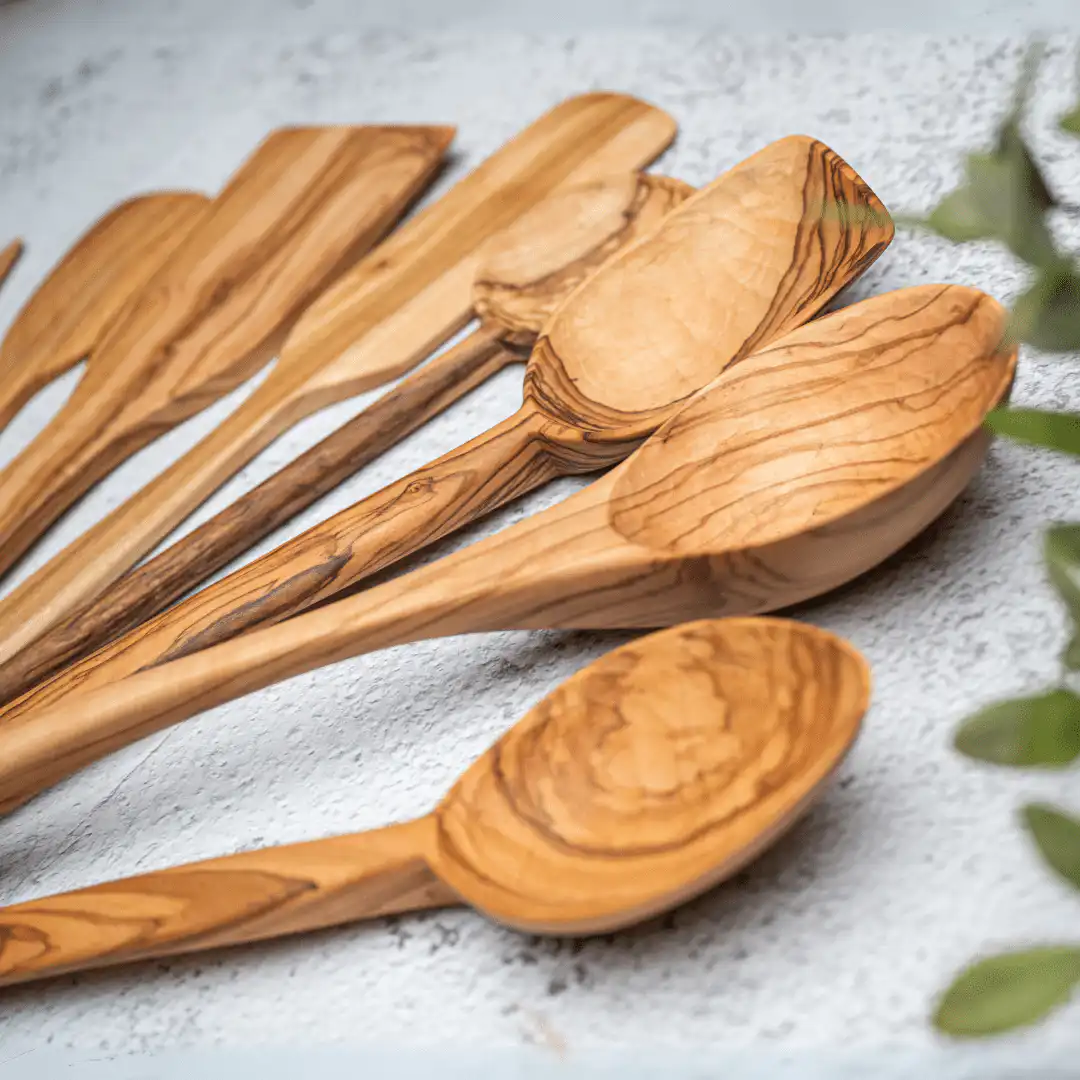
What is olive wood, and why is it used for utensils?
Olive wood is the dense, slow-grown timber of the olive tree, and its hardness is exactly what makes it good for kitchen tools. On the Janka scale, which measures a wood's resistance to denting, olive wood comes in around 2,700 lbf — well above hard maple (about 1,450) and red oak (about 1,290), according to the Wood Database and woodworking references.
That density does real work in a kitchen. Tightly packed grain means the wood absorbs less moisture, resists staining, and doesn't hold onto odors the way softer, more porous materials can. Rinse a garlicky spoon with soap and warm water and it comes clean, ready for the next dish.
The grain is also why no two pieces look alike — cream and amber run through with darker streaks, different in every spoon. Our olive wood comes from wild, reclaimed trees on the Greek island of Lesvos. Much of it would otherwise have been burned as firewood; instead it's hand-carved into something built to last. There's more on that in Olive Wood from Lesvos: What the Wood Carries.
Is olive wood better than bamboo, plastic, or other woods?
For everyday cooking, olive wood outperforms bamboo and plastic on durability and longevity — but "better" depends on what you're weighing. A well-made maple or beech spoon is also a perfectly good tool; olive wood's edge is density, looks, and lifespan, not that everything else is bad.
| Material | Durability | Care | Notes |
|---|---|---|---|
| Olive wood | Very high (dense hardwood) | Hand-wash, dry, occasional oil | Stain/odor resistant; one-of-a-kind grain; pricier |
| Bamboo | Moderate | Hand-wash, dry | Often glued/laminated; can splinter over time |
| Plastic | Low–moderate | Dishwasher-safe | Scratches trap bacteria; sheds microplastics as it wears |
| Maple/beech | High | Hand-wash, dry, occasional oil | Solid, affordable; less dramatic grain |
Plastic is the one clear step down: as it scratches, those grooves trap bacteria, and worn plastic sheds microplastics into food. Bamboo is genuinely eco-friendly and cheap, but it's frequently made from glued strips that can separate or splinter with heavy use. We go deeper in Olive Wood vs Bamboo vs Plastic.
Are olive wood utensils sanitary and food-safe?
Yes — properly maintained wooden utensils are sanitary, and research has found wood often harbors fewer surviving bacteria than plastic. Wood's own structure pulls moisture, and the bacteria in it, below the surface, where the bacteria dry out and die instead of multiplying.
That said, wood is not a sanitizer, and it's worth being clear about that. The real risks are cracks, long soaks, and the dishwasher — a spoon that's split or left sitting in water can trap food and bacteria in ways a sound, dry one won't. Finished olive wood used for brief stirring, then washed and dried, is one of the safest tools in your kitchen.
We treat this as its own subject in Are Wooden Cooking Utensils Sanitary? What Science Says, including when to retire a piece.
How do you care for olive wood?
Care is simple: wash by hand, dry right away, and condition every month or two. That's most of it. Olive wood is forgiving as long as it isn't soaked or run through a dishwasher, where heat and moisture can crack it.
Conditioning is the one step people skip. Wood loses moisture as household humidity changes, and without a periodic coat of food-safe oil or a linseed-and-beeswax butter, it can dry out, go pale, or crack along the grain. A thin coat rubbed in with the grain, left to absorb, then buffed off, keeps a piece looking alive for years.
Our full routine — which oils to use, how often, and how to handle a small crack — lives on our olive wood care guide. It's the page to bookmark.
Hand-carved vs. machine-made: does it matter?
It matters for finish, shape, and character. Machine-made utensils are limited by their tooling, so they come out uniform; hand-carving isn't, so shapes can follow the wood and the hand instead of a mold.
In our workshop on Lesvos, our artisans shape each piece with traditional hand tools. That's why the bowls sit at slightly different angles, why the handles are comfortable in a way stamped utensils often aren't, and why every piece keeps the grain it was born with. Each one is hand-engraved with the initials of the person who carved it, and a QR code lets you meet your maker.
If you want to meet one of them, From the Grove to the Gallery follows a displaced artisan learning the craft and building a new life around it.
Which olive wood utensils should you start with?
Start with the pieces you'll reach for daily: a cooking spoon, a ladle, and one specialty tool. Most kitchens don't need a wall of utensils — they need a few good ones that last.
A deep-bowl cooking spoon is the workhorse for stirring and scraping. A soup ladle earns its place the moment you make a pot of anything, and ours comes in an extra-large 13-inch size for stews. From there, a spurtle is the quiet favorite — a rod-shaped Scottish tool that stirs porridge, risotto, and sauces without clumping.
If you're buying for someone else, sets arrive gift-ready with a Greek recipe card, an our story card, and a meet the maker scannable barcode. Engraved pieces also work well as customer and employee gifts for businesses.
None of this is complicated, which is the point. A good olive wood spoon is a piece of a tree that was headed for a fire, shaped by hand by someone rebuilding a life, and made to outlast the person who buys it. Wash it, dry it, oil it now and then, and it'll be in your kitchen for a very long time.
Frequently asked questions
Keep reading