
Stories & Craft
From the Grove to the Gallery: How a Displaced Artisan in Lesvos Carves a New Future
By Lesvos Woodcraft · 10/1/2023
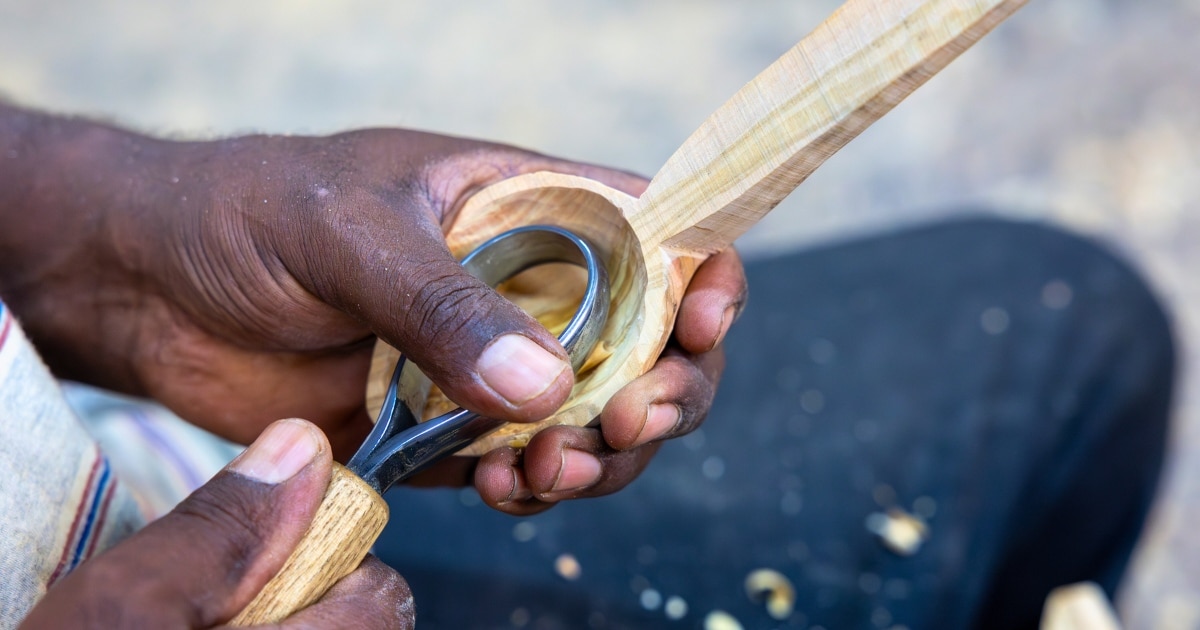
There’s a moment in the workshop that I never get tired of. A man picks up a raw olive branch — something that two weeks ago was going to be burned as winter fuel — and he runs his thumb along the grain. He’s figuring out what’s inside it. What it wants to become. And then he starts cutting.
That moment is the whole story of what we do here on Lesvos.
What “Refugee-Made Gifts” Actually Means
You may have searched for that phrase — refugee-made gifts, handmade by refugees, artisan products supporting displaced people — because you want your purchase to mean something. A lot of companies use language like that. Fewer of them can show you the specific workshop, the specific men, and the specific process behind every piece they sell.
We can.
Lesvos Woodcraft operates a small workshop here on the island of Lesvos, Greece — one of the first points of land that hundreds of thousands of displaced people reached when crossing the Aegean. Many of the men we work with came that way. They arrived with nothing, spent years in uncertainty, and when we met them, they were looking for something most people don’t name clearly: useful work. Not charity. Not temporary assistance. Work that uses their hands and builds something they can be proud of.
That’s what the workshop is. And the products it produces are what you’ll find on our website.
The Vocational Training: Learning to Read Wood
When someone joins the workshop, the first thing we teach them is how to see wood — not as a piece of material to be processed, but as a living structure with its own logic. Olive wood in particular is demanding. It grows slowly, on rocky hillsides, in thin soil, under strong Mediterranean sun. That stress is what gives it the tight, swirling grain patterns you see in a finished piece. It’s also what makes it hard to work with.
Training begins with the fundamentals: how to safely use a hook knife, bandsaws, and many other small hand tools, how to identify the direction of the grain before you cut against it, how to feel when the wood is resisting you versus when it’s yielding. These aren’t things you can learn from a video. They come from doing the same motion a thousand times until your hands understand what your eyes can’t fully see.
Most of our artisans come in with no formal woodworking background. Within a few months, they’re producing pieces that are indistinguishable from the work of craftsmen who’ve been at it for decades.
Refugee-Made Gifts That Start as Firewood
Here’s something most people don’t know about olive wood products: the wood we use would otherwise have no commercial value. Olive trees on Lesvos are pruned annually — sometimes heavily — and the cut branches are typically bundled and burned. We source that material before it reaches the fire.
So when you hold one of our spoons or cutting boards, you’re holding something that started as agricultural waste. The journey from there to your kitchen drawer goes something like this.
Here’s something most people don’t know about how we work: we process our wood while it’s still green.
Most commercial woodworking does the opposite — kiln-dry the lumber first, then machine it into shape. We do it the other way around, and there’s a real reason for it. When olive wood is freshly cut, it’s still holding moisture from the tree. That moisture keeps the fibers soft and workable. A hook knife — the curved blade an artisan uses to carve out the bowl of a spoon — can move through green wood the way a sharp knife moves through firm fruit. Dry the wood first and that same cut becomes a fight. You’d need power tools where a skilled hand can do the work more precisely.
So when logs arrive at the workshop, we seal the ends immediately. The ends of a log are where moisture escapes fastest, and if we let them dry unevenly from the ends inward, the wood checks — it splits along the grain in ways that can’t be corrected. Sealing the ends lets us control the drying timeline and keeps the log workable for longer.
From there, the process moves through the bandsaw. We slice the logs into slabs, then cut the slabs into blanks — rough rectangular pieces sized for whatever the finished piece will be. For a spoon, the blank gets its basic profile cut out at this stage: the length, the general width, the beginning of the shape. Then, while the wood is still green and soft, the artisan takes over with hand tools.
Then the hook knife carves out the bowl. Every cut is a negotiation with the grain — olive wood curves and twists with the life of the tree that grew it, and a skilled artisan follows that movement rather than fighting it. This stage, done by hand in green wood, is where the character of each piece is established. No two spoons look alike because no two branches grew the same way.
Once the bowl carving and shape of the rest of the piece is done, the piece goes into air drying — several months, until the moisture content drops below ten percent. Drying after shaping, rather than before, means the piece can move slightly as it dries, which is why the artisan leaves a little extra material to account for that movement. It requires experience to anticipate correctly.
When the moisture is where it needs to be, the finishing equipment takes over: sanders working through progressively finer grits until the grain pattern that was hidden under the rough surface comes fully alive. This is the moment that still surprises people new to the workshop — hours of gray, dusty work, and then suddenly there’s color, depth, movement in the wood.
Finally, food-safe finish is applied, raw cold pressed lin-seed oil and beeswax. And then a stamp: the initials of the artisan who made it. Every piece that leaves this workshop carries one person’s mark. That’s not a branding decision — it’s an acknowledgment that a specific person made this specific thing, and that it matters who did the work.
Why This Work Matters Beyond the Product
I want to be direct about something, because I think it often gets lost in the way mission-driven businesses talk about themselves.
The men in our workshop are not charity cases. They’re skilled workers who’ve been through something most of us can barely imagine, and they came out of it looking for a way to build something for themselves. What we offer is not sympathy — it’s employment. Stable, skill-building, dignifying employment that pays fair wages and gives them a reason to show up and get better at something every day.
That matters in ways that are hard to quantify but easy to see. When a man produces a beautiful piece of work — something that ends up on a table in Indiana or Ohio or Texas — he knows he made that. His hands did that. There’s a kind of quiet satisfaction in skilled craft that I think is genuinely rare in modern life, and watching people discover it for the first time never gets old for me.
The refugee crisis on Lesvos didn’t end when it fell out of the news. People are still here, still in transition, still trying to figure out what comes next. We’re one small part of what “what comes next” can look like.
Refugee-Made Gifts Worth Giving
When people ask us what to buy — for a housewarming, for a corporate gift, for a wedding — we usually ask them one question first: do you want something that will be used, or something that will be kept?
Because our products are both. A handmade olive wood spoon gets used every day and improves with age. A charcuterie board becomes a centerpiece and then gets passed down. A set of utensils becomes the thing someone reaches for without thinking.
The mission behind them doesn’t make them more functional. But I think it’s worth knowing where things come from — who made them, and what it meant to make them. That context is part of what you’re giving when you give one of these pieces to someone you care about.
You can explore what’s currently available at lesvoswoodcraft.com. If you have questions about bulk orders, corporate gifting, or logo engraving, reach out directly — we’re a small operation and we actually answer.
Lesvos Woodcraft is a mission-driven small business operating on the island of Lesvos, Greece. Our workshop employs displaced artisans and ships handcrafted olive wood products to customers across the United States through our fulfillment center in Amboy, Indiana.